
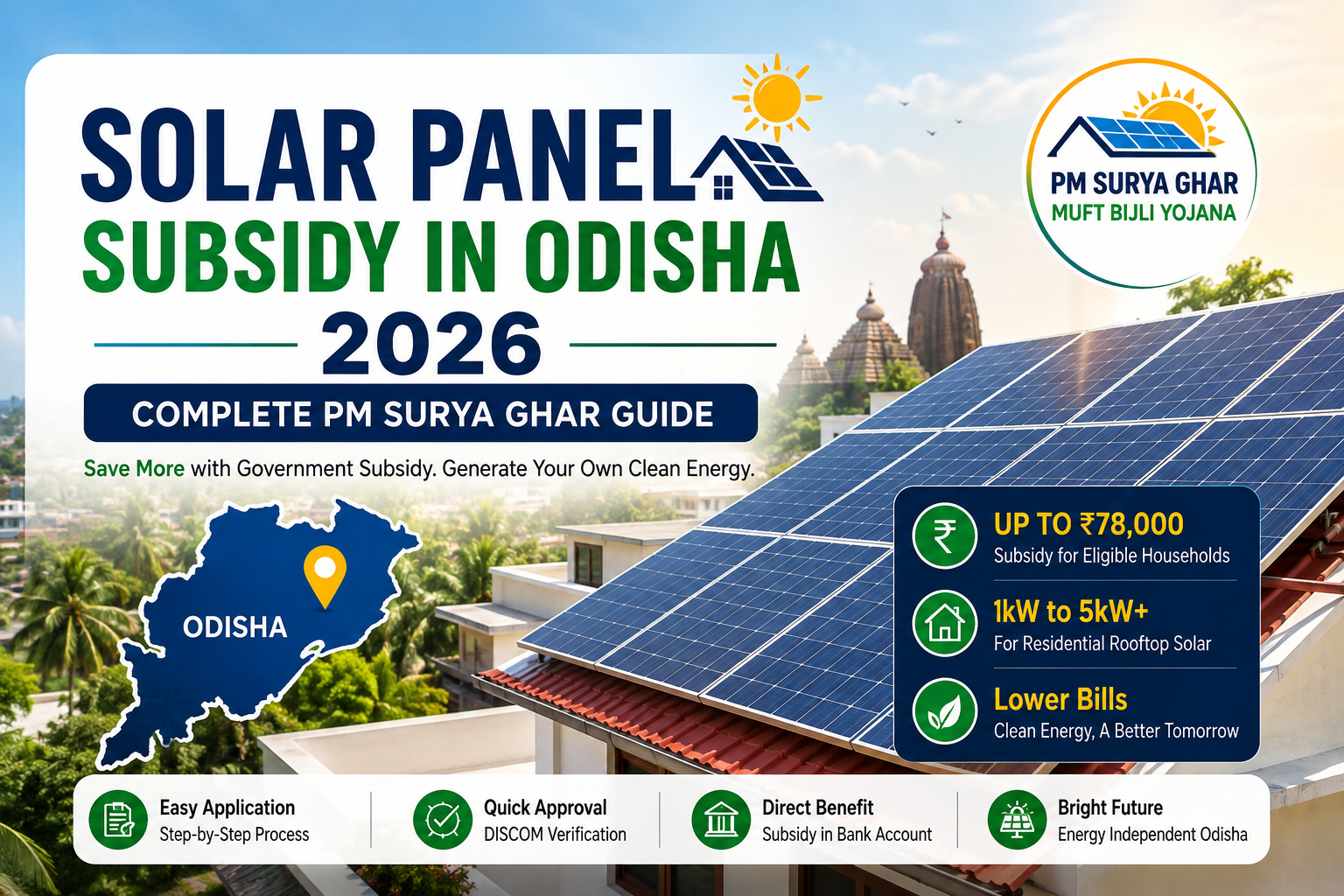
Solar Panel Subsidy in Odisha 2026: Complete PM Surya Ghar Guide
Updated for 2026 | SolarSol
Thinking about installing solar panels on your home in Odisha? The PM Surya Ghar: Muft Bijli Yojana has made residential rooftop solar significantly more affordable by providing eligible households with Central Financial Assistance (CFA).
For homeowners searching for the solar subsidy in Odisha, understanding the subsidy amount is only the beginning. You also need to know which solar system is right for your home, who is eligible, how the application works, what happens after installation, and how the subsidy reaches you.
This complete PM Surya Ghar Odisha guide explains the process in simple terms.
What Is PM Surya Ghar: Muft Bijli Yojana?
PM Surya Ghar: Muft Bijli Yojana is a Government of India initiative designed to encourage residential households to install rooftop solar systems.
Instead of depending entirely on electricity supplied by the grid, a rooftop solar system allows your home to generate electricity from sunlight.
For eligible residential consumers, the government provides financial assistance toward the installation of qualifying rooftop solar systems.
For families in Odisha, this can substantially reduce the effective cost of going solar.
Solar Panel Subsidy Odisha 2026: How Much Can You Get?
Under the applicable Central Financial Assistance structure for individual residential households:
| Rooftop Solar Capacity | Central Subsidy |
|---|---|
| 1 kW | ₹30,000 |
| 2 kW | ₹60,000 |
| 3 kW | ₹78,000 |
| 4 kW | ₹78,000 |
| 5 kW | ₹78,000 |
| 6 kW and above | ₹78,000 maximum |
How is the subsidy calculated?
The structure is simple:
For the first 2 kW: ₹30,000 per kW
For the additional capacity up to 3 kW: ₹18,000 per kW
Therefore:
1 kW → ₹30,000
2 kW → ₹60,000
3 kW → ₹78,000
For an individual residential household, increasing the system beyond 3 kW does not keep increasing the Central subsidy—the CFA is capped at ₹78,000 for systems larger than 3 kW.
Why Is 3 kW Solar So Popular?
For many households, a 3 kW rooftop solar system sits in an attractive middle ground between generation capacity and subsidy support.
The Central subsidy calculation is:
First 2 kW: 2 × ₹30,000 = ₹60,000
Additional 1 kW: 1 × ₹18,000 = ₹18,000
Total Central subsidy = ₹78,000
That makes 3 kW particularly interesting because it reaches the maximum Central subsidy available to an individual residential household under the standard CFA structure.
However, bigger isn't automatically better.
Your ideal solar capacity should be selected according to your actual electricity consumption, sanctioned load, available rooftop area, local technical feasibility and applicable DISCOM requirements.
Who Is Eligible for Solar Subsidy in Odisha?
The subsidy is intended for eligible residential electricity consumers installing qualifying grid-connected rooftop solar systems.
Broadly, a homeowner considering PM Surya Ghar Odisha should have:
- A residential electricity connection
- Suitable rooftop space for solar installation
- A system meeting the applicable technical and scheme requirements
- An application processed through the prescribed PM Surya Ghar/DISCOM procedure
- Installation that satisfies the applicable scheme requirements
- Successful inspection/verification and commissioning as required
Eligibility should always be verified against the latest rules applicable to the particular consumer and installation.
Is PM Surya Ghar Subsidy Available for Commercial Solar?
This is an important distinction.
The residential Central Financial Assistance discussed in this guide is meant for the residential sector.
A shop, factory, office, warehouse or other commercial establishment should therefore not assume that the same ₹30,000/₹60,000/₹78,000 residential subsidy structure will apply to its solar installation.
Commercial solar can still make financial sense because of electricity-cost savings, but it should be evaluated separately from residential PM Surya Ghar CFA.
How to Apply for PM Surya Ghar in Odisha
The process can look complicated at first, but it becomes easier when divided into stages.
Step 1: Register on the PM Surya Ghar Portal
Start your application through the official PM Surya Ghar system.
You will generally need to identify details such as your:
- State
- Electricity distribution company (DISCOM)
- Consumer/account information
- Mobile/contact details
Make sure the information entered matches your electricity connection records.
Step 2: Submit Your Rooftop Solar Application
After registration, proceed with the rooftop solar application and enter the required information about the proposed installation.
Don't choose solar capacity simply because a larger number sounds better.
A properly sized system should be based primarily on your electricity consumption and site conditions.
Step 3: Complete the Required DISCOM Process
Your electricity distribution company plays an important role in the rooftop solar process.
Depending on the applicable procedure, technical feasibility and other requirements may need to be completed before the project progresses.
Odisha's electricity consumers are served by different DISCOMs depending on their location.
Step 4: Select an Eligible/Registered Vendor
Vendor selection matters.
Solar is an investment expected to operate for decades, so don't compare installers only on the lowest quotation.
Consider factors such as:
- Solar module quality
- Inverter quality
- Mounting structure
- Electrical protection
- Workmanship
- Warranty
- After-sales support
- Installation experience
- Compliance with PM Surya Ghar requirements
A cheap system that performs poorly for years can ultimately be far more expensive than a properly engineered installation.
Step 5: Install the Rooftop Solar System
Once the required process is completed, the solar plant can be installed according to the approved specifications and applicable technical requirements.
A typical grid-connected residential rooftop system includes:
Solar Panels → Inverter → Protection Equipment → Home Electrical System → Meter/Grid
During sunny hours, your rooftop system generates electricity that can be used by your home.
What Is Net Metering?
Net metering is one of the most important concepts to understand before installing rooftop solar.
Your solar system may sometimes generate more electricity than your home is consuming at that moment.
A suitable metering arrangement measures electricity flows associated with your grid-connected solar installation according to the applicable regulations.
In simple terms:
Your rooftop becomes a small electricity-generating asset.
Instead of your home only consuming grid electricity, it can generate solar electricity as well.
The exact billing and settlement treatment depends on the applicable Odisha regulations and your DISCOM, so consumers should check the current rules rather than assuming every exported unit will be treated in a particular way.
What Happens After Solar Installation?
Installation itself is not necessarily the final step.
The system must go through the required post-installation process, which can include activities such as:
- Installation completion
- Submission of required system details
- Metering-related process
- DISCOM inspection/verification
- Commissioning
- Completion of subsidy-related documentation
- Processing of eligible CFA
The exact sequence can depend on the applicable portal and DISCOM procedure.
How Do You Receive the PM Surya Ghar Subsidy?
Under the scheme framework, eligible Central Financial Assistance is linked to successful installation and verification of the rooftop solar system.
Consumers should ensure their application, installation details and bank information are accurate.
The subsidy should never be treated as guaranteed merely because solar panels have been installed. The installation and consumer must satisfy the applicable scheme conditions and complete the required verification process.
Can Solar Really Give You 300 Units of Free Electricity?
The phrase “Muft Bijli” can sometimes be misunderstood.
Solar panels do not create a government entitlement under which every household automatically receives 300 free grid units every month.
Instead, the scheme is designed to enable households to generate a significant portion of their electricity through rooftop solar.
The actual electricity generated by your system depends on several factors, including:
- Solar system capacity
- Available sunlight
- Season
- Weather
- Roof orientation
- Shading
- Module efficiency
- Dust and cleanliness
- System losses
- Installation quality
Your actual electricity-bill savings will therefore depend on both solar generation and your household's electricity consumption pattern.
How Much Electricity Can a 3 kW Solar System Generate?
There is no single guaranteed generation figure for every 3 kW installation.
Generation changes throughout the year.
For example, a rooftop with good sunlight and minimal shading may perform substantially better than another 3 kW system surrounded by trees or buildings.
This is why SolarSol recommends looking at your actual electricity consumption and rooftop conditions before deciding your solar capacity.
Will Solar Work During Odisha's Monsoon?
Yes, solar panels can still generate electricity when the weather is cloudy because photovoltaic panels can use available sunlight rather than requiring extreme heat.
However, generation is generally lower during heavily cloudy or rainy conditions compared with bright sunny conditions.
Annual performance matters more than judging a solar plant based on one rainy day.
Does Solar Work During a Power Cut?
This is another common misconception.
A standard on-grid solar system normally shuts down when the grid goes down for safety reasons.
This helps prevent the solar system from feeding electricity into grid lines while technicians may be working on them.
If backup power during outages is important to you, ask your installer about appropriate hybrid solar and energy-storage solutions.
The system design and economics will be different from a normal subsidy-oriented on-grid rooftop installation.
How Much Roof Space Do You Need?
The exact space requirement depends on the solar modules, their wattage, layout, tilt, access pathways, roof shape and shading.
Before installation, your rooftop should therefore be surveyed.
A good solar survey considers:
- Usable roof area
- Direction
- Shadows from nearby structures
- Water tanks
- Trees
- Parapet walls
- Roof condition
- Mounting structure
- Safe maintenance access
Two houses with the same roof size may not have the same usable solar area.
Which Solar System Should You Choose?
Here's a simple way to start thinking about capacity:
| System | Suitable Starting Point |
|---|---|
| 1 kW | Small household / relatively low consumption |
| 2 kW | Small-to-medium household |
| 3 kW | Medium household with higher regular consumption |
| 4–5 kW | Larger household / higher electricity usage |
| 5 kW+ | High-consumption homes |
This is only a general guide.
Your electricity bill is a much better starting point than the size of your house.
A large house with low electricity consumption may need less solar than a smaller house running multiple ACs and other high-load appliances.
5 Common Mistakes to Avoid When Installing Solar in Odisha
1. Choosing Solar Based Only on Subsidy
The goal isn't to install the system with the biggest subsidy.
The goal is to install the right system for your electricity consumption.
2. Selecting the Cheapest Vendor
Solar is a long-term investment.
Poor-quality mounting, wiring, inverter selection or installation can hurt performance and safety.
3. Ignoring Rooftop Shading
Even a premium solar panel cannot perform at its best when its access to sunlight is compromised.
4. Expecting Your Electricity Bill to Automatically Become Zero
Your bill after solar depends on generation, consumption, fixed charges, applicable tariffs and metering/billing rules.
5. Believing Solar Means Automatic Backup
Standard on-grid solar and backup solar are not the same thing.
Ask about this before installation.
Is Rooftop Solar Worth It in Odisha in 2026?
For many eligible homeowners with sufficient electricity consumption and a suitable rooftop, solar deserves serious consideration.
Why?
1. Government Financial Assistance
Eligible residential consumers can receive substantial Central Financial Assistance under PM Surya Ghar.
2. Lower Dependence on Grid Electricity
Every unit of solar electricity that effectively offsets electricity you otherwise would have purchased can contribute to long-term savings.
3. Long-Term Energy Generation
Quality solar modules are designed for long operating lives, making rooftop solar a long-term energy investment rather than a short-term purchase.
4. Protection Against Future Electricity Costs
Generating part of your electricity at home can reduce your exposure to future changes in grid electricity costs.
5. Cleaner Energy
Solar power generates electricity without burning fossil fuel at the point of generation.
PM Surya Ghar Odisha: Frequently Asked Questions
What is the solar subsidy for 1 kW in Odisha?
Under the applicable Central CFA structure for eligible residential consumers, 1 kW can receive up to ₹30,000.
What is the subsidy for 2 kW solar in Odisha?
An eligible 2 kW residential rooftop solar system can receive up to ₹60,000 in Central CFA.
What is the subsidy for 3 kW solar in Odisha?
An eligible 3 kW residential system can receive up to ₹78,000 in Central CFA.
What is the subsidy for a 5 kW solar system?
For an individual residential household, the Central CFA does not continue increasing beyond 3 kW under the standard structure. Therefore, a qualifying 5 kW system is generally subject to the ₹78,000 maximum Central CFA cap.
Is PM Surya Ghar available in Odisha?
Yes. PM Surya Ghar is being implemented in Odisha, subject to the applicable scheme, DISCOM and technical requirements.
Can I get solar subsidy for my shop?
The individual residential CFA described in this article is for eligible residential consumers, not ordinary commercial installations.
Can solar eliminate my electricity bill?
Solar can significantly reduce grid electricity consumption, but a zero bill should not be guaranteed. Your final bill depends on generation, consumption, tariffs, fixed charges and applicable billing/net-metering rules.
Is subsidy available before installation?
Consumers should not assume the CFA is simply handed over before a system is installed. The subsidy process is linked to the prescribed installation, verification and scheme procedures.
Ready to See Whether Solar Makes Sense for Your Home?
The first question shouldn't be:
“How much does solar cost?”
It should be:
“How much electricity am I paying for over the next 20–25 years if I don't go solar?”
Your electricity bill is a recurring expense.
A rooftop solar system gives you the opportunity to generate part of that electricity on your own roof.
If you're considering solar panel installation in Odisha, SolarSol can help you understand your electricity consumption, estimate a suitable system capacity and navigate the rooftop solar installation journey.
Start With Your Electricity Bill
Share your recent electricity bill with SolarSol to understand:
Your recommended solar capacity → Estimated solar generation → Applicable subsidy → Estimated savings → Suitable installation plan
SolarSol — Turn Your Rooftop Into Your Power Source.
*Disclaimer: Subsidy amounts, eligibility conditions, technical requirements, DISCOM procedures, net-metering rules and government-scheme guidelines may be amended from time to time. The figures in this article refer to the applicable Central Financial Assistance structure reviewed for this 2026 guide. Consumers should verify current eligibility and applicable benefits through the official PM Surya Ghar/MNRE system and their electricity distribution company before making a financial decision.*